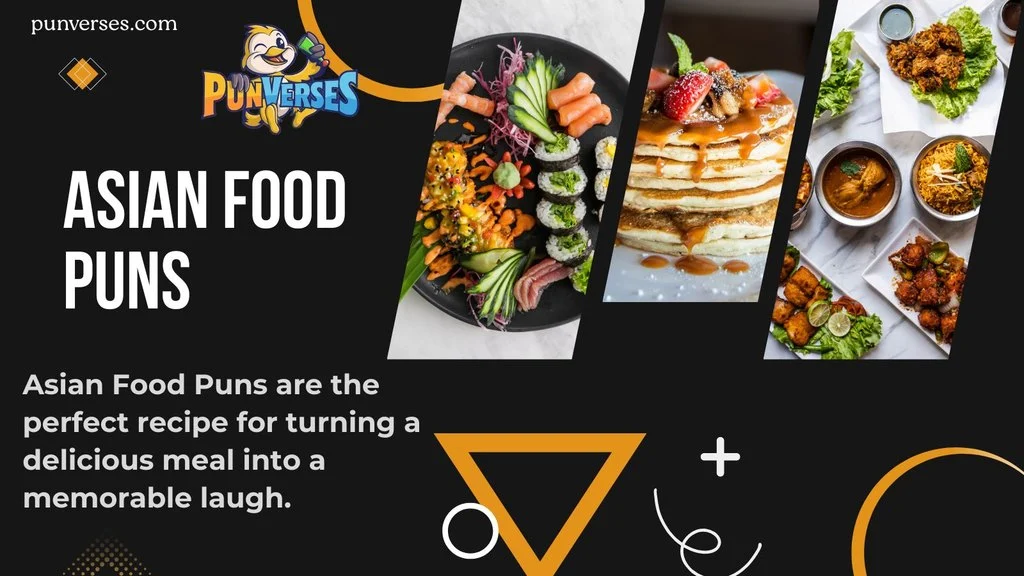
Asian Food Puns are the perfect recipe for turning a delicious meal into a memorable laugh. Whether you’re posting a bowl of ramen on Instagram, sharing sushi with friends, writing a birthday card, or simply trying to make your family groan at the dinner table, the right food pun can add a little extra flavor to the moment.
This collection is goes beyond basic one liners. You’ll find funny Asian food puns, clever captions, cute jokes, romantic wordplay, restaurant friendly ideas, family safe humor, and dish specific jokes inspired by sushi, ramen, dumplings, bao, boba, curry, noodles, rice, mochi, matcha, and more.
Why do people love this kind of humor? Because food is already social. We eat it together, photograph it, recommend it, celebrate with it, and talk about it constantly. A short pun gives all that familiar food language a surprising little twist.
You’ll find these jokes useful for Instagram, TikTok, birthday cards, greeting cards, classroom activities, texts between friends, family conversations, restaurant marketing, menus, blogs, newsletters, and social media posts.
Asian Food Puns are playful jokes that twist the names, sounds, ingredients, cooking terms, or eating experiences associated with Asian dishes into humorous phrases. They work especially well for captions, jokes, cards, menus, conversations, and food blogs because familiar words like sushi, soy, rice, ramen, bao, pho, curry, boba, and noodles naturally lend themselves to wordplay.
What’s Inside?
| Section | Best For |
|---|---|
| Funny Asian Food Puns | Everyday laughs |
| Clever Asian Food Puns | Wordplay lovers |
| Short Asian Food Puns | Quick captions |
| Asian Food One-Liners | Texts and conversations |
| Sushi Puns | Sushi photos |
| Ramen & Noodle Puns | Food posts |
| Dumpling & Bao Puns | Cute content |
| Rice, Curry & Spice Puns | Food lovers |
| Boba, Matcha & Dessert Puns | Drinks and sweets |
| Romantic Asian Food Puns | Couples |
| Asian Food Instagram Captions | Social media |
| Asian Food Puns for Kids | Family-friendly humor |
| How to Create Food Puns | Writers and creators |
| How to Use Asian Food Puns | Bloggers and marketers |
| FAQs | Quick answers |
What Are Asian Food Puns?
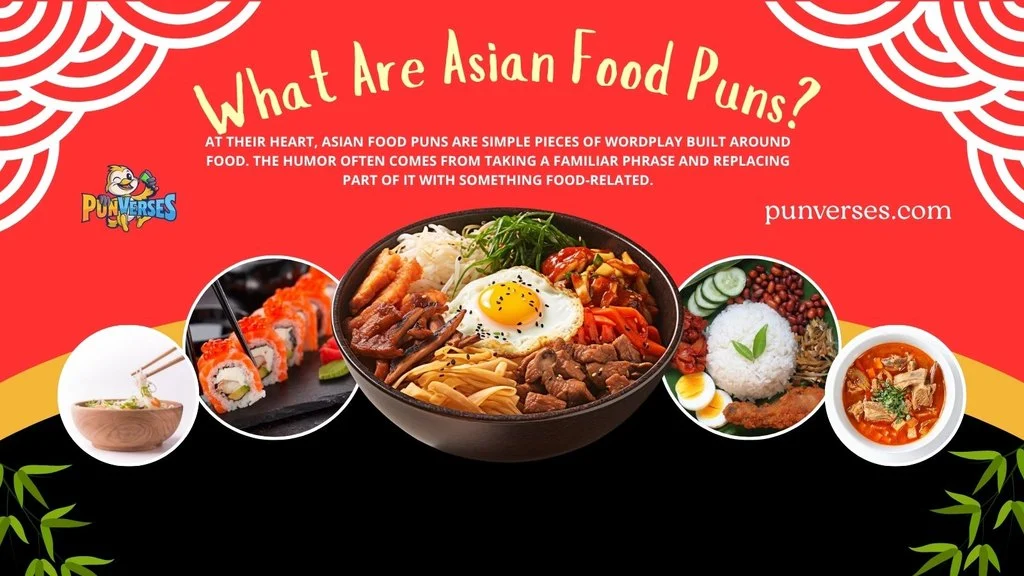
At their heart, Asian Food Puns are simple pieces of wordplay built around food. The humor often comes from taking a familiar phrase and replacing part of it with something food-related.
For example, imagine turning “make it happen” into “maki it happen.” The joke works because maki is associated with sushi rolls while the original phrase remains recognizable.
That little collision between an ordinary expression and a food word is what makes the joke work.
Good food puns usually have three ingredients: a familiar phrase, a recognizable food reference, and a small surprise. You don’t need an elaborate setup. In fact, the shorter the joke, the better it often performs as a caption.
Asian cuisines also give writers an enormous playground. Sushi, ramen, dumplings, noodles, rice, soy sauce, curry, bao, pho, kimchi, boba, matcha, mochi, and many other foods have distinctive names or sounds that can inspire wordplay.
The important thing is to keep the humor focused on food and language rather than stereotypes about Asian people or cultures. That keeps the jokes welcoming, respectful, and easy to share.
Here are a few examples:
Example 1
Pun: “I came for one dumpling. I left with a full-filling.”
Meaning: “Filling” refers to what is inside a dumpling while also suggesting emotional satisfaction.
Why It’s Funny: The word has two meanings, and the second one arrives unexpectedly.
Best Used For: Food captions and texts.
Example 2
Pun: “My noodle plan is working out beautifully.”
Meaning: It plays on having a “new plan” while connecting the joke to noodles.
Why It’s Funny: The sound shift creates a tiny linguistic surprise.
Best Used For: Casual conversations and noodle photos.
Example 3
Pun: “This meal has excellent wok ethic.”
Meaning: “Wok ethic” sounds like “work ethic.”
Why It’s Funny: A serious phrase suddenly gets a culinary makeover.
Best Used For: Restaurant posts and foodie captions.
Why Are Asian Food Puns So Popular?
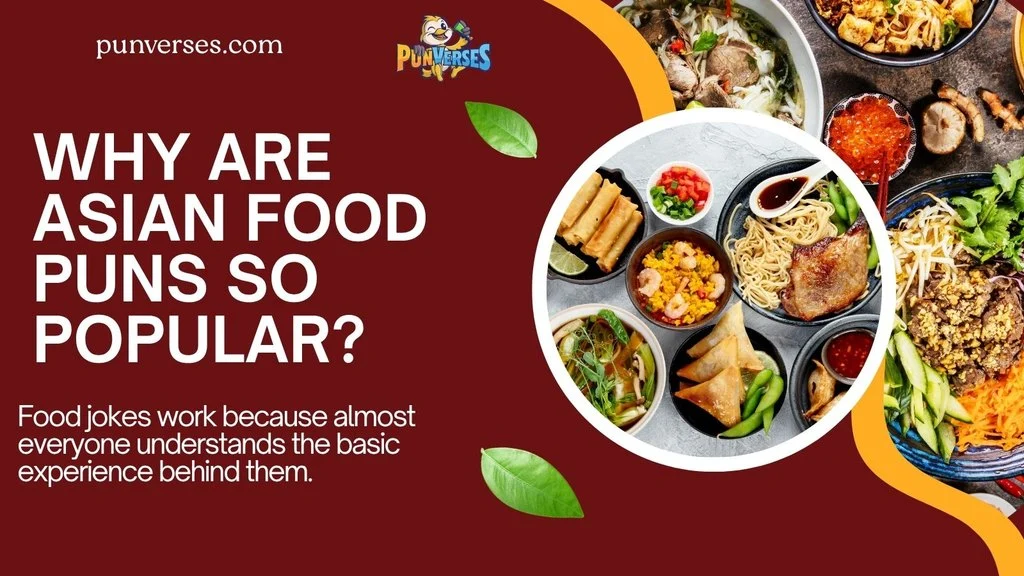
Food jokes work because almost everyone understands the basic experience behind them. You don’t need a long explanation to understand a joke about ordering too much food, fighting over the last dumpling, or taking a picture of noodles before eating them.
From a humor-writing perspective, recognition is one of the strongest tools in a pun. The reader sees the original phrase in their head, notices the food-related twist, and gets the joke almost instantly.
Social media makes this even more useful. A food photo usually tells part of the story visually. The caption only needs to add personality.
For example, a photo of a steaming ramen bowl already looks delicious. A caption like “Noodle-ing my way through the weekend” gives it a playful voice without requiring a paragraph.
These jokes are also flexible.
A teacher can use them in a classroom activity. A parent can use them with children. A restaurant can add playful language to a menu. A food blogger can use one as a section opener. A friend can drop one into a group chat.
The best part is that the joke doesn’t have to be perfect. Sometimes the deliberately terrible pun is the funniest one because everyone knows it is terrible.
That is the magic of dad-joke humor: the groan is part of the applause.
Funny Asian Food Puns

Funny Asian Food Puns should feel quick, playful, and easy to understand. The goal isn’t to make readers solve a crossword puzzle before they laugh. Instead, these jokes take familiar food words and give them a silly new job.
They’re especially useful when you want humor that works in ordinary conversation. You can use them while ordering dinner, sending a food photo, commenting on a friend’s post, or trying to make someone laugh over lunch.
The following lines are written to stay clean and broadly shareable.
1. 🍜 Pun
“I’m having a pho-nomenal day.”
Meaning: “Pho-nomenal” combines pho with phenomenal.
Why It’s Funny: The food name slides naturally into a familiar compliment.
Best Used For: Pho photos and casual captions.
2. 🥢 Pun
“This dinner really knows how to wok the room.”
Meaning: It twists “rock the room” with wok.
Why It’s Funny: The dramatic phrase becomes unexpectedly culinary.
Best Used For: Restaurant posts.
3. 🍚 Pun
“Rice and shine!”
Meaning: It replaces “rise and shine” with rice.
Why It’s Funny: One tiny vowel change transforms the morning phrase.
Best Used For: Breakfast posts or food stories.
4. 🍣 Pun
“I’m on a roll, and thankfully, so is my sushi.”
Meaning: “On a roll” describes success while also describing sushi.
Why It’s Funny: One phrase works literally and figuratively.
Best Used For: Sushi captions.
5. 🥟 Pun
“I’m taking life one dumpling at a time.”
Meaning: It adapts the familiar “one day at a time” idea.
Why It’s Funny: The serious life advice becomes deliciously impractical.
Best Used For: Instagram and TikTok.
6. 🍱 Pun
“Lunch has officially entered its bento era.”
Meaning: It treats a bento box like a fashionable personal era.
Why It’s Funny: “Era” language is usually used for people or trends, not lunch boxes.
Best Used For: Food photography.
7. 🥢 Pun
“Chopsticks: because forks needed a plot twist.”
Meaning: The chopstick choice is framed like a dramatic story change.
Why It’s Funny: It gives an everyday utensil unnecessary cinematic importance.
Best Used For: Short captions.
8. 🍜 Pun
“I followed my heart. It led me to noodles.”
Meaning: It turns a romantic phrase into a food confession.
Why It’s Funny: The emotional destination is unexpectedly dinner.
Best Used For: Foodie posts.
9. 🥠 Pun
“My fortune says I should order dessert.”
Meaning: It pretends a fortune cookie has given permission for another course.
Why It’s Funny: It uses the idea of fortune-cookie predictions for a very convenient conclusion.
Best Used For: Restaurant photos.
10. 🌶️ Pun
“Things are getting spicy, but I’m handling it with great soy-lf-control.”
Meaning: “Soy-lf-control” twists “self-control.”
Why It’s Funny: The soy reference is hidden inside a familiar phrase.
Best Used For: Spicy food captions.
Clever Asian Food Puns

Clever Asian Food Puns rely more heavily on word construction. They reward readers who notice double meanings, sound-alikes, and familiar expressions hiding inside food terminology.
These are useful when a basic “food word + normal phrase” joke isn’t enough. Clever doesn’t have to mean complicated. In fact, the best clever pun often looks obvious only after you’ve seen it.
For writers, this category is especially useful because it demonstrates an important principle: the strongest puns usually begin with language, not food.
Start with a phrase people already know. Then ask whether a dish, ingredient, or cooking term can replace one word without destroying the meaning.
1. 🍜 Pun
“I’m udon with all the drama.”
Meaning: “Udon” sounds like “you don’t.”
Why It’s Funny: The noodle becomes part of a conversational statement.
Best Used For: Group chats.
2. 🍣 Pun
“You maki my day better.”
Meaning: “Maki” replaces “make” in “make my day.”
Why It’s Funny: The sushi reference fits inside a familiar compliment.
Best Used For: Friendly captions.
3. 🥢 Pun
“I have a strong wok ethic.”
Meaning: It changes “work ethic” into “wok ethic.”
Why It’s Funny: The phrase still sounds completely natural while suddenly referring to cooking.
Best Used For: Food blogs and restaurant humor.
4. 🍚 Pun
“Let’s rice to the occasion.”
Meaning: It plays on “rise to the occasion.”
Why It’s Funny: The original phrase remains recognizable despite the rice substitution.
Best Used For: Encouraging messages.
5. 🥟 Pun
“I’m feeling very well-wrapped today.”
Meaning: It connects emotional composure with a wrapped dumpling.
Why It’s Funny: It treats a dumpling as if it had a personal wellness routine.
Best Used For: Cute food posts.
6. 🍵 Pun
“Matcha later, I have snacks to investigate.”
Meaning: “Matcha” sounds like “meet you.”
Why It’s Funny: It turns a goodbye into a matcha joke.
Best Used For: Tea captions.
7. 🥠 Pun
“The future looks for-tune-ate.”
Meaning: It blends “fortune” with “fortunate.”
Why It’s Funny: It references the classic fortune-cookie experience.
Best Used For: Fortune-cookie photos.
8. 🍜 Pun
“I’m committed to a bowl-anced lifestyle.”
Meaning: “Balanced” becomes “bowl-anced.”
Why It’s Funny: The bowl becomes part of a wellness phrase.
Best Used For: Ramen posts.
9. 🍡 Pun
“Sweet decisions are my mochi-vation.”
Meaning: “Mochi” replaces part of “motivation.”
Why It’s Funny: Dessert suddenly becomes a life coach.
Best Used For: Dessert photos.
10. 🥢 Pun
“I’m just here for the main course of action.”
Meaning: It combines “course” with “course of action.”
Why It’s Funny: A meal becomes a serious strategic plan.
Best Used For: Restaurant captions.
Short Asian Food Puns
Sometimes you don’t need a paragraph. You need six words that fit neatly under a photo.
Short Asian Food Puns are ideal for Instagram, TikTok captions, comments, text messages, stickers, menu boards, and social posts. They also work well when the image already provides most of the context.
A useful rule for short puns is to remove every word that doesn’t contribute to the joke. If the pun still works after trimming it down, you’ve probably found a strong caption.
Here are quick options for those moments when the food deserves the spotlight.
1. 🍜 Pun
“Noodle mood activated.”
Meaning: Your mood is officially noodle-focused.
Why It’s Funny: It treats dinner like a software setting.
Best Used For: Ramen photos.
2. 🍣 Pun
“Roll with sushi.”
Meaning: It blends the idea of rolling with sushi rolls.
Why It’s Funny: The wording is short but has two meanings.
Best Used For: Sushi captions.
3. 🍚 Pun
“Rice, rice, baby.”
Meaning: It replaces “ice” with rice.
Why It’s Funny: The rhythm makes the food reference instantly recognizable.
Best Used For: Rice dishes and party posts.
4. 🧋 Pun
“Boba-lieve in yourself.”
Meaning: “Boba” replaces part of “believe.”
Why It’s Funny: A drink becomes motivational.
Best Used For: Boba photos.
5. 🍵 Pun
“Matcha mood.”
Meaning: A short phrase connecting matcha with your current vibe.
Why It’s Funny: It sounds like a lifestyle trend.
Best Used For: Matcha posts.
6. 🥟 Pun
“Dumpling around.”
Meaning: A playful variation of “dawdling around.”
Why It’s Funny: It turns hanging around into dumpling behavior.
Best Used For: Dumpling photos.
7. 🍜 Pun
“Ramen-tically involved.”
Meaning: It blends ramen with romantically involved.
Why It’s Funny: The noodle bowl becomes a relationship status.
Best Used For: Couples or foodie posts.
8. 🌶️ Pun
“Spice mode: ON.”
Meaning: You’re ready for spicy food.
Why It’s Funny: It sounds like activating a device.
Best Used For: Hot dishes.
9. 🍡 Pun
“Mochi magic.”
Meaning: A simple phrase celebrating mochi.
Why It’s Funny: The chewy dessert gets a magical reputation.
Best Used For: Dessert captions.
10. 🥢 Pun
“Chopstick chic.”
Meaning: It treats chopsticks as a fashion statement.
Why It’s Funny: It gives dinner utensils runway energy.
Best Used For: Stylish food photography.
Asian Food One-Liners
One-liners are built for quick laughs. They don’t need a setup because the setup and punchline arrive together.
This makes them especially useful in conversations. You can drop one into a text without explaining why you’re suddenly talking about food.
The secret to a good one-liner is rhythm. Read each sentence aloud. If the punch lands naturally at the end, you’ve got something worth keeping.
1. 🍜 Pun
“I tried to stop eating noodles, but I couldn’t pasta chance.”
Meaning: “Past a chance” is twisted into a pasta-related expression.
Why It’s Funny: The language turns a failed attempt at restraint into a noodle confession.
Best Used For: Noodle lovers.
2. 🍣 Pun
“Sushi isn’t just food; it’s a roll model.”
Meaning: It changes “role model” to “roll model.”
Why It’s Funny: Sushi rolls suddenly become inspirational figures.
Best Used For: Sushi posts.
3. 🥟 Pun
“I trust dumplings because they always come wrapped with good intentions.”
Meaning: Dumplings are wrapped, while people can arrive with good intentions.
Why It’s Funny: It gives an edible object a personality trait.
Best Used For: Family humor.
4. 🍚 Pun
“Rice doesn’t solve every problem, but it has a pretty grain solution.”
Meaning: “Grain” replaces “great.”
Why It’s Funny: It sounds like serious advice until the rice vocabulary appears.
Best Used For: Rice dishes.
5. 🍵 Pun
“Matcha is proof that good ideas can be steeped over time.”
Meaning: Tea is steeped while ideas develop gradually.
Why It’s Funny: It combines a cooking process with creative thinking.
Best Used For: Tea lovers and writers.
6. 🧋 Pun
“Boba is the only meeting where everyone agrees to bring their own pearls.”
Meaning: Boba drinks contain tapioca pearls.
Why It’s Funny: It turns a drink into a fictional workplace meeting.
Best Used For: Office humor.
7. 🍜 Pun
“My ramen and I have a very broth-minded relationship.”
Meaning: It plays on “broad-minded” while referencing broth.
Why It’s Funny: The soup gets credit for emotional compatibility.
Best Used For: Ramen captions.
8. 🌶️ Pun
“I ordered mild, but my taste buds filed an appeal.”
Meaning: The food was spicier than expected.
Why It’s Funny: Taste buds are treated like lawyers.
Best Used For: Spicy-food stories.
9. 🥠 Pun
“My fortune cookie told me to expect great things, so I ordered dessert.”
Meaning: It interprets fortune-cookie optimism as dessert permission.
Why It’s Funny: The prediction becomes suspiciously convenient.
Best Used For: Restaurant conversations.
10. 🍱 Pun
“A good bento box is basically lunch with excellent organization skills.”
Meaning: Bento meals are neatly arranged.
Why It’s Funny: The food is described like an organized coworker.
Best Used For: Lunch captions.
Sushi Puns
Sushi is one of the easiest foods to build wordplay around because words like roll, rice, raw, maki, sashimi, soy, wasabi, and chopsticks create multiple paths for jokes.
Sushi puns work particularly well on social media because sushi photographs beautifully. A clean pun can add personality without distracting from the food.
For sushi content, avoid overloading the caption with jokes. One strong line usually beats five mediocre ones.
1. 🍣 Pun
“Sushi and me? We’re on a roll.”
Meaning: “On a roll” describes success and sushi itself.
Why It’s Funny: The phrase works both literally and figuratively.
Best Used For: Couple photos or sushi nights.
2. 🍣 Pun
“Maki room for one more.”
Meaning: “Make room” becomes “maki room.”
Why It’s Funny: A sushi style becomes part of an everyday phrase.
Best Used For: Group dinners.
3. 🍣 Pun
“Sushi a wonderful night.”
Meaning: “Such a wonderful night” becomes sushi-themed.
Why It’s Funny: The sound-alike is quick and recognizable.
Best Used For: Dinner captions.
4. 🍣 Pun
“Rice to meet you, roll to see you.”
Meaning: It combines rice with a sushi roll and familiar greetings.
Why It’s Funny: The sentence feels like a tiny sushi-themed introduction.
Best Used For: Restaurant posts.
5. 🍣 Pun
“Keep calm and roll with it.”
Meaning: “Roll” references sushi while keeping the original expression.
Why It’s Funny: The food reference is subtle rather than forced.
Best Used For: Sushi reels.
6. 🍣 Pun
“Wasabi-lieve it or not, this is my happy place.”
Meaning: Wasabi replaces the beginning of “was, believe it or not.”
Why It’s Funny: The spicy condiment becomes the opening of a dramatic statement.
Best Used For: Wasabi-heavy meals.
7. 🍣 Pun
“I’m soy into this sushi.”
Meaning: Soy sauce becomes part of “so into.”
Why It’s Funny: A sauce becomes a declaration of enthusiasm.
Best Used For: Casual captions.
8. 🍣 Pun
“This sushi deserves a standing ovation, but my chopsticks are busy.”
Meaning: The meal is so good you want to applaud.
Why It’s Funny: The chopsticks create an absurd practical obstacle.
Best Used For: Food reviews.
9. 🍣 Pun
“Sushi night has excellent roll chemistry.”
Meaning: It plays on “role chemistry” while referencing sushi rolls.
Why It’s Funny: A meal is treated like a successful cast of characters.
Best Used For: Dinner posts.
10. 🍣 Pun
“Raw talent, perfectly rolled.”
Meaning: “Raw” references sushi while also describing natural talent.
Why It’s Funny: Two meanings fit into three words.
Best Used For: Sushi photography.
Ramen and Noodle Puns
Ramen and noodles are comfort-food royalty, which makes them excellent material for humor.
The best noodle jokes often use words such as bowl, broth, slurp, twist, tangled, noodle, ramen, udon, and chow mein. You can also build jokes around the experience of eating noodles: the slippery noodles, the giant bowl, the dramatic slurp, and the eternal struggle of getting one stubborn strand onto your fork or chopsticks.
1. 🍜 Pun
“I’m having a bowl of a time.”
Meaning: “Bowl of a time” twists “ball of a time.”
Why It’s Funny: The bowl becomes the center of the experience.
Best Used For: Ramen captions.
2. 🍜 Pun
“Noodle know what I’d do without this.”
Meaning: “Noodle” replaces “wouldn’t know.”
Why It’s Funny: It turns uncertainty into noodle wordplay.
Best Used For: Comfort-food posts.
3. 🍜 Pun
“I’m tangled up in my feelings—and these noodles.”
Meaning: Noodles physically tangle while feelings can be complicated.
Why It’s Funny: Emotional drama meets a very practical noodle problem.
Best Used For: Instagram captions.
4. 🍜 Pun
“Slurp happens.”
Meaning: It replaces the first word of a familiar expression with a noodle-eating sound.
Why It’s Funny: It turns an eating accident into a life philosophy.
Best Used For: Ramen photos.
5. 🍜 Pun
“Ramen calm and carry on.”
Meaning: Ramen replaces “remain.”
Why It’s Funny: A noodle dish becomes motivational advice.
Best Used For: Stress-relief posts.
6. 🍜 Pun
“This bowl has me feeling souper confident.”
Meaning: “Souper” sounds like “super.”
Why It’s Funny: Soup gets upgraded into a personality booster.
Best Used For: Brothy dishes.
7. 🍜 Pun
“Udon even know how happy this makes me.”
Meaning: Udon sounds like “you don’t.”
Why It’s Funny: The noodle name fits naturally into a sentence.
Best Used For: Noodle lovers.
8. 🍜 Pun
“I like my weekends hot, steamy, and full of noodles.”
Meaning: It describes both a weekend mood and a bowl of ramen.
Why It’s Funny: The dramatic description ends with something completely ordinary.
Best Used For: Weekend captions.
9. 🍜 Pun
“No need to stir up trouble when you can stir up ramen.”
Meaning: It contrasts drama with cooking.
Why It’s Funny: It turns a common phrase into kitchen advice.
Best Used For: Cooking posts.
10. 🍜 Pun
“My noodle bowl has more layers than my personality.”
Meaning: The joke compares ingredients with personal complexity.
Why It’s Funny: The bowl becomes a metaphor for human character.
Best Used For: Self-deprecating captions.
Dumpling and Bao Puns
Dumplings and bao are perfect for cute humor because their shapes and fillings naturally lend themselves to words like wrapped, folded, filled, stuffed, pocket, bun, and bao.
These jokes are especially good for family posts, restaurant content, food blogs, and couples because they can be sweet without becoming overly sentimental.
1. 🥟 Pun
“You had me at dumpling.”
Meaning: It adapts “you had me at hello.”
Why It’s Funny: A romantic line gets redirected toward dinner.
Best Used For: Dumpling photos.
2. 🥟 Pun
“You’re the filling to my dumpling.”
Meaning: It compares a loved one with the filling inside a dumpling.
Why It’s Funny: It turns food structure into relationship language.
Best Used For: Couples.
3. 🥟 Pun
“Bao and behold, dinner has arrived.”
Meaning: “Bao” replaces “lo.”
Why It’s Funny: A dramatic announcement becomes food-related.
Best Used For: Dinner posts.
4. 🥟 Pun
“Everything is better when it comes wrapped.”
Meaning: It refers to wrapped dumplings.
Why It’s Funny: It sounds like life advice but secretly talks about food.
Best Used For: Dumpling captions.
5. 🥟 Pun
“I’m feeling bao-tiful today.”
Meaning: “Bao” replaces part of “beautiful.”
Why It’s Funny: A steamed bun becomes a compliment.
Best Used For: Cute posts.
6. 🥟 Pun
“This dumpling is absolutely filling the brief.”
Meaning: It combines dumpling filling with completing a task.
Why It’s Funny: Food is treated like a successful employee.
Best Used For: Food reviews.
7. 🥟 Pun
“Wrapped, packed, and ready to snack.”
Meaning: It describes dumplings while sounding like a playful rhyme.
Why It’s Funny: The rhythm makes the line memorable.
Best Used For: Takeout posts.
8. 🥟 Pun
“Bao goals achieved.”
Meaning: A food version of “goal achieved.”
Why It’s Funny: A bun becomes a milestone.
Best Used For: Restaurant stories.
9. 🥟 Pun
“Dumpling is always up when dinner is this good.”
Meaning: It twists “something is always up” into dumpling wordplay.
Why It’s Funny: The grammar is intentionally silly.
Best Used For: Family humor.
10. 🥟 Pun
“My love language is handing you the last dumpling.”
Meaning: Sharing the final piece becomes a sign of affection.
Why It’s Funny: Anyone who loves dumplings knows how serious that sacrifice can be.
Best Used For: Couples and friends.
Rice, Curry, Spice, and Soy Puns
Rice and spice give you some of the most flexible ingredients for wordplay. Rice sounds like “rise,” curry can suggest “carry,” soy fits naturally into “so,” and spice can describe both flavor and personality.
These jokes work particularly well for Indian, Thai, Chinese, Korean, and other Asian-inspired food content, but it’s worth remembering that Asia contains an enormous range of distinct cuisines. Specific food references are usually more interesting than treating all Asian food as one category.
1. 🍚 Pun
“Rice to the challenge.”
Meaning: It twists “rise to the challenge.”
Why It’s Funny: Rice becomes a motivational verb.
Best Used For: Food posts and encouragement.
2. 🌶️ Pun
“I’ve got a spice for everything.”
Meaning: It plays on “space for everything.”
Why It’s Funny: A kitchen ingredient replaces an everyday word.
Best Used For: Cooking captions.
3. 🍛 Pun
“Curry on, my friend.”
Meaning: It changes “carry on” to “curry on.”
Why It’s Funny: Curry becomes motivational advice.
Best Used For: Curry photos.
4. 🥢 Pun
“Soy glad you came.”
Meaning: Soy replaces “so.”
Why It’s Funny: The sauce becomes part of a friendly welcome.
Best Used For: Dinner invitations.
5. 🌶️ Pun
“Spice to meet you.”
Meaning: “Nice to meet you” becomes spice-themed.
Why It’s Funny: The greeting gets a culinary upgrade.
Best Used For: Restaurant introductions.
6. 🍚 Pun
“Rice expectations, excellent results.”
Meaning: It twists “high expectations” into rice-related language.
Why It’s Funny: Rice becomes a measure of quality.
Best Used For: Food reviews.
7. 🌶️ Pun
“I like my humor with a little kick.”
Meaning: “Kick” describes both spicy food and energetic humor.
Why It’s Funny: It connects taste and personality.
Best Used For: Spicy food posts.
8. 🍛 Pun
“This curry is carrying the whole dinner.”
Meaning: Curry is described as doing all the work.
Why It’s Funny: The dish becomes the responsible member of the group.
Best Used For: Restaurant captions.
9. 🍚 Pun
“Rice and easy.”
Meaning: It adapts “nice and easy.”
Why It’s Funny: Rice becomes a calming life instruction.
Best Used For: Rice dishes.
10. 🥢 Pun
“Soy into this flavor.”
Meaning: “So into” becomes soy-themed.
Why It’s Funny: A sauce turns enthusiasm into a pun.
Best Used For: Food photos.
Boba, Matcha, Mochi, and Dessert Puns
Dessert and drink puns tend to perform well because they’re naturally cute. Boba pearls, matcha, mochi, and other sweets give captions a playful personality without needing an elaborate joke.
These are excellent choices for TikTok videos, café photos, birthday posts, study breaks, and casual lifestyle content.
1. 🧋 Pun
“Boba-fide happiness.”
Meaning: “Bona fide” becomes boba-themed.
Why It’s Funny: A serious phrase suddenly describes a drink.
Best Used For: Bubble tea photos.
2. 🍵 Pun
“Matcha made in heaven.”
Meaning: Matcha replaces “match.”
Why It’s Funny: A romantic expression becomes a tea compliment.
Best Used For: Matcha drinks.
3. 🍡 Pun
“Mochi love, mochi happiness.”
Meaning: “More” or “much” style repetition becomes mochi wordplay.
Why It’s Funny: The dessert itself becomes the source of affection.
Best Used For: Cute captions.
4. 🧋 Pun
“Pearl-fectly timed boba break.”
Meaning: “Perfectly” becomes “pearl-fectly.”
Why It’s Funny: The tapioca pearls get top billing.
Best Used For: Study posts.
5. 🍵 Pun
“Matcha-ing my energy.”
Meaning: Matcha becomes part of “matching.”
Why It’s Funny: It makes tea sound like an emotional accessory.
Best Used For: Lifestyle content.
6. 🍡 Pun
“Mochi grateful for this dessert.”
Meaning: “Much” becomes mochi.
Why It’s Funny: Gratitude becomes dessert-based.
Best Used For: Thank-you posts.
7. 🧋 Pun
“Boba is always a good idea.”
Meaning: It treats bubble tea as universally reliable.
Why It’s Funny: The statement is exaggerated with cheerful confidence.
Best Used For: Café captions.
8. 🍵 Pun
“Whisking my worries away with matcha.”
Meaning: Whisking matcha becomes a metaphor for reducing stress.
Why It’s Funny: A real preparation step becomes emotional therapy.
Best Used For: Wellness posts.
9. 🍡 Pun
“Life is sweeter when you take the mochi road.”
Meaning: It twists the idea of taking the “rocky road.”
Why It’s Funny: A dessert becomes a life philosophy.
Best Used For: Dessert content.
10. 🧋 Pun
“Sip happens, especially when there’s boba.”
Meaning: “Sip” replaces the first part of a familiar expression.
Why It’s Funny: It turns a drink into a cheeky explanation for everything.
Best Used For: Bubble tea captions.
Romantic Asian Food Puns
Romantic food puns work best when they are affectionate without becoming overly serious.
Food is already connected to relationships. Couples go out for dinner, share appetizers, steal fries, argue over dessert, and remember favorite restaurants. That gives you plenty of material.
The trick is to make the food reference feel like part of the romantic message rather than simply attaching a random dish name to “I love you.”
1. ❤️ Pun
“You’re soy much more than a dinner date.”
Meaning: “Soy” replaces “so.”
Why It’s Funny: A familiar romantic phrase gets a sauce-based twist.
Best Used For: Valentine’s messages.
2. ❤️ Pun
“You maki my heart roll.”
Meaning: Maki and roll reference sushi while expressing affection.
Why It’s Funny: The entire romantic sentence becomes sushi-themed.
Best Used For: Couples.
3. ❤️ Pun
“We’re a perfect matcha.”
Meaning: Matcha replaces “match.”
Why It’s Funny: A tea drink becomes relationship compatibility.
Best Used For: Valentine’s cards.
4. ❤️ Pun
“You’re my main squeeze and my favorite side dish.”
Meaning: It combines romance with restaurant language.
Why It’s Funny: The partner gets promoted to the entire menu.
Best Used For: Anniversary messages.
5. ❤️ Pun
“Our love is on a roll.”
Meaning: It refers to sushi while describing a successful relationship.
Why It’s Funny: The romantic metaphor has an edible meaning.
Best Used For: Anniversary captions.
6. ❤️ Pun
“You’re the bao to my heart.”
Meaning: Bao becomes the food-related centerpiece of a romantic line.
Why It’s Funny: The phrase is intentionally cute and food-forward.
Best Used For: Cute couple posts.
7. ❤️ Pun
“I’d share my last dumpling with you.”
Meaning: Giving away the final dumpling is presented as the ultimate act of love.
Why It’s Funny: Food lovers understand the seriousness of the sacrifice.
Best Used For: Romantic cards.
8. ❤️ Pun
“You’re the sweet ending to every meal.”
Meaning: A partner is compared with dessert.
Why It’s Funny: It’s romantic but still grounded in food.
Best Used For: Anniversary messages.
9. ❤️ Pun
“You spice up my life without burning my taste buds.”
Meaning: Spice represents excitement while also referring to food heat.
Why It’s Funny: It keeps the romantic metaphor edible.
Best Used For: Couples.
10. ❤️ Pun
“Together, we’re a recipe for good times.”
Meaning: A relationship is compared with a successful recipe.
Why It’s Funny: The romance is framed like cooking instructions.
Best Used For: Anniversary cards.
Asian Food Instagram Captions
Instagram captions need to be short, visual, and easy to scan.
When someone sees a bowl of ramen, a sushi platter, colorful curry, or a cup of boba, the photo already provides the context. Your caption shouldn’t compete with it.
A strong caption usually adds personality, emotion, or a tiny joke.
Try these:
1. 📸 Pun
“Currently in my noodle era.”
Meaning: Your current obsession is noodles.
Why It’s Funny: It borrows social-media “era” language.
Best Used For: Ramen photos.
2. 📸 Pun
“Serving looks and sushi.”
Meaning: It combines appearance with dinner.
Why It’s Funny: “Serving” works in both fashion and food contexts.
Best Used For: Stylish restaurant photos.
3. 📸 Pun
“Good food, good mood, great chopsticks.”
Meaning: A simple rhythm connecting food happiness with the meal.
Why It’s Funny: The chopsticks get an unnecessary promotion.
Best Used For: Instagram posts.
4. 📸 Pun
“Caught feelings. Ordered dumplings.”
Meaning: Emotional feelings are paired with food.
Why It’s Funny: The second sentence changes the direction completely.
Best Used For: Casual posts.
5. 📸 Pun
“Bowl goals.”
Meaning: Your meal is the goal.
Why It’s Funny: It transforms “goals” language into food language.
Best Used For: Ramen and rice bowls.
6. 📸 Pun
“Powered by noodles and questionable decisions.”
Meaning: Noodles are your fuel while your decisions remain humorous.
Why It’s Funny: It combines comfort food with self-deprecating humor.
Best Used For: Late-night food posts.
7. 📸 Pun
“Soy happy right now.”
Meaning: Soy replaces “so.”
Why It’s Funny: A tiny word swap creates the joke.
Best Used For: Foodie selfies.
8. 📸 Pun
“Just here for the extra sauce.”
Meaning: It can refer literally to food sauce and metaphorically to wanting more excitement.
Why It’s Funny: It leaves the meaning slightly open.
Best Used For: Restaurant photos.
9. 📸 Pun
“Chopstick confidence: questionable. Appetite: unstoppable.”
Meaning: The caption jokes about utensil skills versus hunger.
Why It’s Funny: The contrast makes the line relatable.
Best Used For: Sushi and noodle posts.
10. 📸 Pun
“Eat well, post better.”
Meaning: It turns food into a social-media mission.
Why It’s Funny: It sounds like a lifestyle slogan.
Best Used For: Food photography.
Asian Food Puns for Kids
Kids usually respond best to simple wordplay. The joke should be understandable without needing cultural or linguistic knowledge.
These lines are clean enough for classrooms, family dinners, children’s lunch notes, food-themed activities, and school newsletters.
1. 👧 Pun
“Why did the noodle bring a pencil?”
Meaning: Because it wanted to draw its own “line.”
Why It’s Funny: Noodles look like lines.
Best Used For: Kids’ jokes.
2. 👦 Pun
“What did the rice say before school?”
Meaning: “I’m ready to rise and shine!”
Why It’s Funny: Rice replaces “rise.”
Best Used For: Morning humor.
3. 🥟 Pun
“Why was the dumpling so calm?”
Meaning: It had everything wrapped up.
Why It’s Funny: “Wrapped up” describes both the dumpling and being organized.
Best Used For: Classroom jokes.
4. 🍜 Pun
“Why did the ramen win the race?”
Meaning: It was always ready to make a fast noodle move.
Why It’s Funny: The answer uses noodle imagery.
Best Used For: Kids’ activities.
5. 🍣 Pun
“Why was the sushi so confident?”
Meaning: It knew how to roll with anything.
Why It’s Funny: “Roll” describes sushi and confidence.
Best Used For: Family humor.
6. 🍚 Pun
“Rice said hello because it was nice.”
Meaning: Rice and nice rhyme.
Why It’s Funny: Simple rhyming wordplay works well with younger readers.
Best Used For: Lunch notes.
7. 🧋 Pun
“Why did the boba go to school?”
Meaning: It wanted to become a little more well-rounded.
Why It’s Funny: A round drink ingredient gets a personality trait.
Best Used For: Kids.
8. 🍵 Pun
“Matcha later!”
Meaning: A playful goodbye involving matcha.
Why It’s Funny: It sounds like a normal phrase.
Best Used For: Classroom snack jokes.
9. 🥢 Pun
“Chopsticks are great at teamwork because they always come in pairs.”
Meaning: Chopsticks naturally work together.
Why It’s Funny: It turns a basic utensil fact into a friendship lesson.
Best Used For: Teachers.
10. 🍡 Pun
“Mochi more fun, mochi more laughs.”
Meaning: “Mochi” replaces “much.”
Why It’s Funny: The repeated sound makes it playful.
Best Used For: Dessert activities.
Asian Food Puns for Birthday Cards
Birthday cards need jokes that are warm enough to feel personal and silly enough to make someone smile.
Food puns are especially useful when you know the recipient loves a particular dish. A sushi fan gets a sushi joke. A boba lover gets a boba joke. Personalization makes even a simple pun feel more thoughtful.
1. 🎂 Pun
“Hope your birthday is soy much fun!”
Meaning: Soy replaces “so.”
Why It’s Funny: The sauce reference gives the birthday wish a food twist.
Best Used For: Foodie friends.
2. 🎂 Pun
“Have a roll-tastic birthday!”
Meaning: “Roll” refers to sushi.
Why It’s Funny: It turns “fantastic” into sushi-themed celebration.
Best Used For: Sushi lovers.
3. 🎂 Pun
“Wishing you a bowl-full of happiness.”
Meaning: It combines “bowlful” with emotional happiness.
Why It’s Funny: Happiness becomes something you can serve.
Best Used For: Ramen fans.
4. 🎂 Pun
“Another year? That’s boba-fide progress.”
Meaning: “Bona fide” becomes boba-fide.
Why It’s Funny: A formal expression gets a bubble-tea makeover.
Best Used For: Boba fans.
5. 🎂 Pun
“Have a rice day on your birthday.”
Meaning: “Nice day” becomes rice day.
Why It’s Funny: It is simple, cheerful, and food-themed.
Best Used For: Family cards.
6. 🎂 Pun
“Hope your birthday is wrapped with good memories.”
Meaning: “Wrapped” references dumplings.
Why It’s Funny: It works as both a heartfelt message and food wordplay.
Best Used For: Dumpling lovers.
7. 🎂 Pun
“Mochi happiness for you this year!”
Meaning: Mochi replaces “much.”
Why It’s Funny: Dessert becomes an emotional quantity.
Best Used For: Dessert lovers.
8. 🎂 Pun
“May your birthday be spicy, sweet, and perfectly seasoned.”
Meaning: It uses food qualities as life wishes.
Why It’s Funny: The birthday person gets treated like an excellent dish.
Best Used For: Friends and family.
9. 🎂 Pun
“Age is just a number. Dessert is a necessity.”
Meaning: It shifts birthday focus toward food.
Why It’s Funny: It makes dessert the important part of aging.
Best Used For: Cake lovers.
10. 🎂 Pun
“Another trip around the sun? Let’s celebrate with another round of noodles.”
Meaning: Birthday celebration becomes another food round.
Why It’s Funny: It treats noodles as a traditional milestone.
Best Used For: Close friends.
Asian Food Puns for Teachers, Friends, and Family
Not every joke needs to be posted online. Some of the best puns happen at the dinner table.
Teachers can use food wordplay as classroom warm-ups or creative writing prompts. Friends can use it in group chats. Families can turn it into a ridiculous competition to see who can make everyone groan first.
The trick is knowing your audience.
1. 👩🏫 Pun
“Let’s wok together and make today great.”
Meaning: Wok replaces “work.”
Why It’s Funny: A classroom teamwork message gets a cooking twist.
Best Used For: Teachers.
2. 👨👩👧 Pun
“Family dinners are where we rice to the occasion together.”
Meaning: Rice replaces rise.
Why It’s Funny: It makes family dinner sound heroic.
Best Used For: Family captions.
3. 👯 Pun
“Friends who share dumplings are friends for life.”
Meaning: Sharing food represents friendship.
Why It’s Funny: It exaggerates the importance of dumpling sharing.
Best Used For: Friend posts.
4. 👩🏫 Pun
“You’re doing a pho-nomenal job.”
Meaning: Pho replaces the start of phenomenal.
Why It’s Funny: A food word becomes encouragement.
Best Used For: Teacher notes.
5. 👨👩👧 Pun
“Our family recipe needs equal parts love and snacks.”
Meaning: Family relationships are compared with recipes.
Why It’s Funny: Snacks are treated like a required ingredient.
Best Used For: Family cards.
6. 👯 Pun
“Good friends never let you face an empty bowl alone.”
Meaning: Friends share meals and support one another.
Why It’s Funny: Emotional support gets translated into dinner support.
Best Used For: Friend captions.
7. 👩🏫 Pun
“Class dismissed. Snacks approved.”
Meaning: It treats snacks like the reward after class.
Why It’s Funny: The official-sounding statement is completely food-focused.
Best Used For: Teachers and students.
8. 👨👩👧 Pun
“Home is where the chopsticks are.”
Meaning: It adapts the phrase “home is where the heart is.”
Why It’s Funny: A utensil replaces an emotional concept.
Best Used For: Family posts.
9. 👯 Pun
“You’re my ride-or-fry friend.”
Meaning: “Ride or die” becomes food-themed.
Why It’s Funny: The friendship is dramatically expressed through fried food.
Best Used For: Best-friend captions.
10. 👩🏫 Pun
“This lesson has officially been seasoned with fun.”
Meaning: Seasoning becomes a metaphor for adding excitement.
Why It’s Funny: A classroom lesson is treated like a dish.
Best Used For: Teachers and classroom content.
Asian Food Puns for Marketing, Restaurants, and Menus
Food businesses can use puns to sound more approachable, but there is an important distinction between fun marketing and forced marketing.
A restaurant name, menu description, social caption, or promotion should remain clear first. The joke should enhance the message rather than make customers decode it.
Short wordplay works especially well for limited-time dishes, social posts, menu categories, loyalty campaigns, and food photography.
1. 🍽️ Pun
“Wok in, hungry out.”
Meaning: It adapts the phrase “walk in” while referencing a wok.
Why It’s Funny: The restaurant invitation becomes culinary.
Best Used For: Restaurant signage.
2. 🍜 Pun
“Broth worth coming back for.”
Meaning: It suggests the soup is memorable.
Why It’s Funny: “Worth” becomes connected with broth without being too complicated.
Best Used For: Menu copy.
3. 🍣 Pun
“Roll in for dinner.”
Meaning: “Roll” references sushi.
Why It’s Funny: It is short, clear, and action-oriented.
Best Used For: Restaurant social media.
4. 🥟 Pun
“Get your fill.”
Meaning: It refers to both satisfaction and dumpling filling.
Why It’s Funny: One phrase works for appetite and ingredients.
Best Used For: Dumpling promotions.
5. 🍚 Pun
“Rice to the occasion.”
Meaning: Rice replaces “rise.”
Why It’s Funny: It works as a motivational phrase and food slogan.
Best Used For: Rice dishes.
6. 🧋 Pun
“Pearl yourself a little happiness.”
Meaning: It references boba pearls.
Why It’s Funny: The phrase sounds like a playful self-care instruction.
Best Used For: Bubble tea marketing.
7. 🍵 Pun
“Matcha your next craving.”
Meaning: Matcha replaces “match.”
Why It’s Funny: It connects the drink with satisfying a craving.
Best Used For: Café marketing.
8. 🌶️ Pun
“Bring your appetite. We’ll bring the spice.”
Meaning: A simple contrast between customer and restaurant.
Why It’s Funny: The restaurant gets a confident culinary personality.
Best Used For: Restaurant promotions.
9. 🥢 Pun
“Chopstick your way to dinner.”
Meaning: Chopsticks become the method of reaching the meal.
Why It’s Funny: It turns an eating utensil into an action verb.
Best Used For: Social campaigns.
10. 🍱 Pun
“Pack your plans around lunch.”
Meaning: It references packed bento-style meals.
Why It’s Funny: Lunch becomes the most important appointment of the day.
Best Used For: Takeout marketing.
How to Use Asian Food Puns
The right pun can make a post memorable. The wrong one can make a perfectly good caption feel forced.
Start with the purpose.
If you’re writing an Instagram caption, keep it short. If you’re writing a birthday card, add warmth. If you’re creating restaurant marketing, make sure customers understand the offer before they notice the joke.
Here are practical ways to use these puns:
- Instagram: Pair one short pun with a strong food photo.
- TikTok: Use the pun as on-screen text or the final line of the video.
- Facebook: Slightly longer jokes work well with family and community posts.
- Birthday cards: Combine the pun with a sincere birthday wish.
- Greeting cards: Match the food joke to the recipient’s favorite dish.
- Teachers: Use simple puns as classroom icebreakers.
- Friends: Drop short one-liners into group chats.
- Family: Use clean jokes around the dinner table.
- Restaurants: Use wordplay in captions, menu sections, and promotions.
- Blogs: Use puns as section openers or social-sharing captions.
- Newsletters: Add one short joke to make food-related emails warmer.
- Food photography: Let the picture provide the context and let the pun provide the personality.
The golden rule is simple: don’t let the pun hide the message.
If you’re promoting a $10 lunch special, make sure readers see the lunch special. The joke is the seasoning, not the meal.
How to Create Your Own Asian Food Puns
Creating original puns becomes much easier when you stop trying to “invent a joke” and start looking for language connections.
Use this five-step method.
Step 1: Choose the Food
Pick one specific item.
Examples:
- Sushi
- Ramen
- Bao
- Dumplings
- Rice
- Curry
- Boba
- Matcha
- Mochi
- Noodles
- Soy
- Wasabi
Specific foods usually produce stronger jokes than a vague phrase like “Asian cuisine.”
Step 2: List Related Words
For ramen, you might write:
bowl, broth, slurp, noodles, hot, steam, soup, twist, tangled.
Now you have raw material.
Step 3: Think of Familiar Expressions
Consider phrases such as:
- Rise and shine
- Make my day
- On a roll
- Work ethic
- Match made in heaven
- Course of action
- Good intentions
- Piece of the puzzle
- Once in a lifetime
Step 4: Look for Sound-Alikes
Now connect the two lists.
For example:
rice + rise = “Rice and shine.”
Or:
maki + make = “Maki my day.”
Step 5: Test the Joke
Ask four questions:
- Can someone understand it quickly?
- Is the original phrase recognizable?
- Does the food reference make sense?
- Would the joke still work without an explanation?
If the answer is yes to most of these, you have a usable pun.
A Simple Formula
You can even use this template:
Familiar phrase + food word + unexpected meaning = pun
For example:
“Match made in heaven” → “Matcha made in heaven.”
The transformation is tiny, but the result feels fresh because the reader recognizes the original phrase immediately.
Common Mistakes When Writing Food Puns
Not every food-related joke deserves a place on the menu.
Here are some mistakes worth avoiding.
1. Forcing Every Food Into a Pun
If a word doesn’t naturally fit, don’t force it.
A weak pun is worse than no pun.
2. Using the Same Joke Repeatedly
Changing one word in the same basic phrase doesn’t create ten different jokes.
Readers notice repetition quickly.
3. Making the Joke Too Complicated
If your reader needs three sentences of explanation, the punchline probably needs another edit.
4. Confusing Cultures and Cuisines
Asia includes many countries, regions, languages, traditions, and cuisines. Avoid treating them as one monolithic culture.
Specific references make better jokes and show greater care.
5. Using Stereotypes
Keep the humor about food, language, cooking, dining, and the situation rather than people’s ethnicity, accents, appearance, or identity.
6. Overloading Captions
One excellent pun can outperform five average ones.
Give the joke room to breathe.
7. Ignoring Context
A restaurant menu needs different humor from a birthday card.
Always ask who will read the joke.
8. Prioritizing SEO Over Humans
A paragraph stuffed with the phrase “Asian Food Puns” every other sentence won’t become more useful.
Write naturally.
Use related language such as:
- Asian food jokes
- food wordplay
- Asian cuisine captions
- sushi jokes
- ramen captions
- dumpling jokes
- boba captions
- funny food captions
- restaurant humor
- foodie jokes
Let the topic vocabulary occur naturally.
Tips for Writing Better Asian Food Puns
Good pun writing is mostly editing.
Start with ten ideas. Keep three. Then improve those three.
Here are some techniques that help.
Keep the Setup Short
The reader should reach the joke quickly.
Prefer Familiar Expressions
“Rise and shine” is easier to recognize than an obscure phrase.
Use Specific Food References
“Sushi” gives you roll, rice, raw, maki, soy, wasabi, and chopsticks.
That’s much more material than simply saying “food.”
Read Your Pun Out Loud
Sound matters.
A pun that looks clever on the screen may sound awkward when spoken.
Use Contrast
A serious phrase becomes funny when food suddenly enters it.
For example:
“course of action” → “course of dinner.”
Add Personality
Instead of simply saying:
“This ramen is good.”
Give it a point of view:
“This ramen has completely ruined my plans to share.”
The second line feels more human.
Don’t Explain Every Joke
The explanations in this article are useful for understanding the wordplay, but your actual social caption usually shouldn’t include:
“Here is why this pun is funny.”
Let readers discover the joke themselves.
Where to Use Asian Food Puns
The beauty of food humor is its flexibility.
Use short captions that complement the photograph.
TikTok
Put the pun on screen at the exact moment the food appears.
Longer jokes and family-friendly humor can work well.
Greeting Cards
Combine one pun with a sincere message.
Birthday Cards
Choose a food connected to the person’s personality.
Restaurants
Use wordplay for promotions, menu categories, social captions, and seasonal campaigns.
Teachers
Use puns to encourage creative thinking and language play.
Bloggers
Turn individual jokes into social-sharing hooks.
Food Creators
Use a recurring pun style to develop a recognizable voice.
Text Messages
Short jokes are perfect for casual conversations.
Group Chats
Food puns become even funnier when everyone is already discussing dinner.
Asian Food Pun Caption Ideas by Mood
Sometimes you don’t know which joke category you need. You simply know the mood.
Happy Mood
“Good food has entered the chat.”
Cozy Mood
“Wrapped up with noodles and zero plans.”
Romantic Mood
“You’re the matcha to my morning.”
Spicy Mood
“Current status: flirting with the spice limit.”
Cute Mood
“Tiny dumplings, giant happiness.”
Funny Mood
“I came, I saw, I ordered everything.”
Lazy Mood
“Today’s workout is lifting chopsticks.”
Weekend Mood
“Weekend plans: wok, eat, repeat.”
Celebration Mood
“Good food deserves a standing ovation.”
Foodie Mood
“I don’t have favorites. I have a rotating menu.”
FAQs:
What are Asian Food Puns?
Asian Food Puns are humorous wordplay based on Asian dishes, ingredients, cooking terms, dining experiences, and food-related words. They’re commonly used for captions, jokes, cards, conversations, restaurant marketing, and blogs.
What are some good Asian Food Puns for Instagram?
Short captions work best. Examples include “Currently in my noodle era,” “Bowl goals,” “Soy happy right now,” and “Caught feelings. Ordered dumplings.”
What are the best Asian food puns for sushi?
Sushi offers excellent wordplay around rolls, rice, soy, maki, raw food, wasabi, and chopsticks. Lines such as “You maki my heart roll” and “Sushi and me? We’re on a roll” work well for captions.
What are some Asian food puns for couples?
Try romantic food wordplay such as “We’re a perfect matcha,” “You maki my heart roll,” or “I’d share my last dumpling with you.” The best romantic food jokes connect the food reference with a recognizable relationship idea.
Are Asian Food Puns appropriate for kids?
Yes, food-focused wordplay can be family-friendly when it avoids stereotypes and keeps the humor centered on dishes, ingredients, cooking, and language. Simple rice, noodle, dumpling, and boba jokes are particularly easy for children to understand.
Can restaurants use Asian Food Puns in marketing?
Yes. Short, clear puns can add personality to restaurant captions, menus, promotions, and social media. However, the joke should never make an important offer, price, dish name, or instruction difficult to understand.
How do I make an original Asian food pun?
Start with a specific dish, list words associated with it, then compare those words with familiar expressions. Look for sound-alikes, double meanings, rhymes, and phrases that can be changed by one food-related word.
What makes a good food pun?
A good food pun is easy to understand, has a recognizable phrase underneath it, creates a small surprise, and fits its context. The strongest puns usually don’t require a long explanation.
Conclusion:
Asian food puns prove that great food and great humor make the perfect pair. From sushi and noodles to ramen, dumplings, rice, and spicy dishes, there’s always a tasty way to add a little laughter to your day. Whether you need a funny caption, a clever message, or simply a pun to share with friends, these Asian food puns are sure to serve up plenty of smiles.